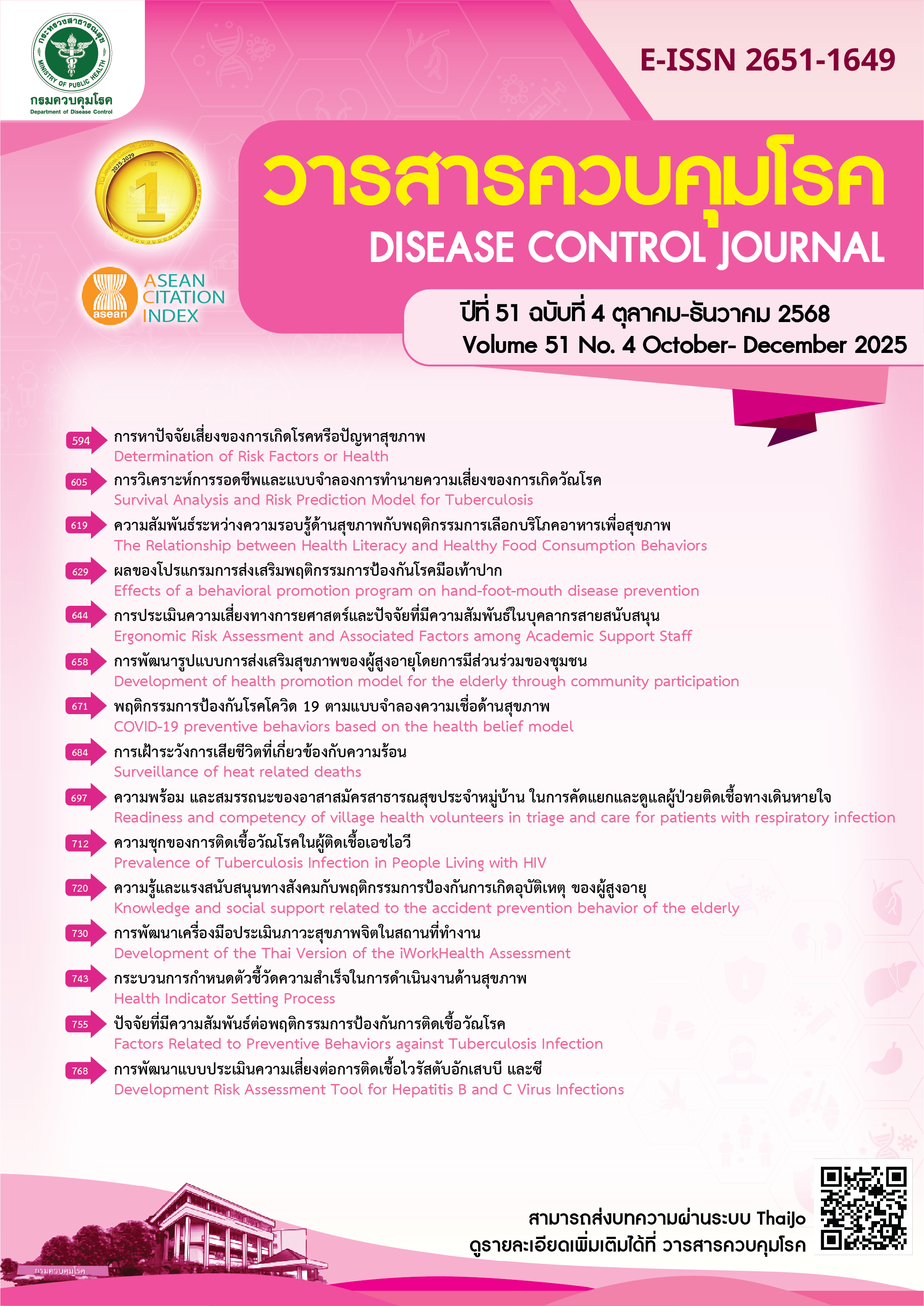
Development of the Thai Version of the iWorkHealth Assessment Tool for Work-Related Mental Health
DOI:
https://doi.org/10.14456/dcj.2025.58Keywords:
iWorkHealth, Mental health in work, workplace stressAbstract
Mental health problems and work are related. Mental health problems can negatively impact work performance, and the work itself can impact a worker's mental health. This study aimed to develop a Thai version of iWorkHealth to be a screening tool for mental health problem in the workplace. The study procedures included requesting permission, translating questions, assessing the validity, trying out, and finalizing the complete instrument. The overall Cronbach Alpha coefficient was 0.65. The results of the separate assessments found that the Cronbach Alpha coefficient of general mental health, psychosocial conditions related to work, work stress and burnout, management of the organization related to mental safety and health of workers were 0.95, 0.97, 0.96 and 0.97 respectively. Although the overall Cronbach Alpha coefficient was lower than 0.70, but the Cronbach alpha coefficients of each dimension were higher than 0.90. However, the corrected item-total correlations varied from 0.21 to 1.00. Therefore, it can be used as a screening tool for mental health conditions in workplaces before referred to experts.
Downloads
References
World Health Organization. Mental health at work 2024 [Internet]. [cited 2024 Dec 20]. Available from: https://www.who.int/news-room/fact-sheets/detail/mental-health-at-work.
Occupational Safety and Health Administration. Workplace Stress 2024 [Internet]. [cited 2024 Dec 20]. Available from: https://www.osha.gov/workplace-stress.
Kittirattanapaiboon P, Tantirangsee N, Chutha W, Tanaree A, Kwansanit P, Assanangkornchai S, et al. Prevalence of mental disorders and mental health problems: Results from Thai national mental health survey 2013 [Internet]. [cited 2024 Dec 20]. Available from: https://www.dmh-elibrary.org/items/show/177. (in Thai)
The Office of the National Economic and Social Development Council. The surveiilance of mental health issue 2024 [Internet]. [cited 25 Dec 2024]. Available from: https://www.nesdc.go.th/download/Social/Social_Report/2567_article_q1_001.pdf. (in Thai)
Thaomor W. Factors Associated to Job Stress among Officers in a General Hospital. Buddhachinaraj Med J. 2020;37(1):49-59. (In Thai)
Department of Mental Health, Ministry of Public Health. RQ : Resilience Quotient [Internet]. [cited 2024 Dec 20]. Available from: https://dmh.go.th/download/dmhnews/kom2008-2.pdf
Kelloway EK, Dimoff JK, Gilbert S. Mental Health in the Workplace. Annu Rev Organ Psychol Organ. Behav. 2023.10:363-87.
Oliveira C, Saka M, Bone L, Jacobs R. The Role of Mental Health on Workplace Productivity: A Critical Review of the Literature. Appl Health Econ Health Policy. 2023;21(2):167-93.
Burton WN, Schultz AB, Chen C, Edington DW. The association of worker productivity and mental health: a review of the literature. Int J Workplace Health Manag. 2008;1(2):78-94.
Bubonya M, Cobb-Clark DA, Wooden M. Mental health and productivity at work: does what you do matter? Labour Econ.2017;46:150-65.
Banerjee S, Chatterji P, Lahiri K. Effects of psychiatric disorders on labor market outcomes: a latent variable approach using multiple clinical indicators. Health Econ. 2017;26(2):184-205.
Christensen MK, Lim CCW, Saha S, Plana-Ripoll O, Cannon D, Presley F, et al. The cost of mental disorders: a systematic review. Epidemiol Psychiatr Sci. 2020;29:e161.
Asami Y, Goren A, Okumura Y. Work productivity loss with depression, diagnosed and undiagnosed, among workers in an Internet-based survey conducted in Japan. J Occup Environ Med. 2015;57(1):105-10.
Phaktongsuk P, Apakupakul N. Validation and modification of Karasek job stress questionnaire in Thai population 2548 [Internet]. [cited 2025 Jan 20]. Available from: https://kb.psu.ac.th/psukb/handle/2010/5831. (in Thai)
World Health Organization. Mental health at work: policy brief 2022 [Internet]. [cited 2024 Dec 20]. Available from: https://www.who.int/publications/i/item/9789240057944.
Maulik PK. Workplace stress: A neglected aspect of mental health wellbeing. Indian J Med Res. 2017;146(4):441-4.
Department of Disease Control, Ministry of Public Health. Healthy, Safety & Good Mental Health Program in the workplaces [Internet]. [cited 2025 Jan 5]. Available from: https://envoccsurvey.ddc.moph.go.th/occhcomm/app/spk/p_performance.php (in Thai)
Department of Mental Health. Stress Test Questionnaire (ST-5) [Internet]. [cited 2025 Jan 2]. Available from: https://kkhos.moph.go.th/kkhos/data_office/ST5.pdf (in Thai)
Department of Mental Health, Ministry of Public Health. The Patient Health Questionnaire (PHQ-2) [Internet]. [cited 2025 Jan 2]. Available from: https://dmh.go.th/test/downloadfiles/2Q%209Q%208Q%20(1).pdf (in Thai)
Schmidt B, Schneider M, Seeger P, van Vianen A, Loerbroks A, Herr RM. A Comparison of Job Stress Models: Associations With Employee Well-Being, Absenteeism, Presenteeism, and Resulting Costs. J Occup Environ Med. 2019;61(7):535-44.
Buapetch A, Kalampakorn S, Lagampan S. Psychosocial Work Environment Factors Relating to Psychological Health Problems and Job Satisfaction of Thai Workers in large-sized Garment Factories. Journal of Public Health. 2555;42(1):5-17. (in Thai)
Choorat S, Thungjaroenkul P, Nantsupawat A. Effort–Reward Imbalance and Job Burnout of Nurses in Tertiary Hospitals. Nursing Journal CMU, 2023;50(2):170-82. (In Thai)
Phaktongsuk P.Construct Validity of the Thai Version of the Job Content Questionnaire in a Large Population of Heterogeneous Occupations.J Med Assoc Thai. 2009;92(4):564-72.
Yingratanasuk T, Piboon K, Julvanichpong T, Inchai P. Job aspects and factors related to job stress among secondary school teachers in Chonburi Province. BJM. 2020;7(1):32-46. (in Thai)
Abdin E, Subramaniam M, Chan A, et al. iWorkHealth: An instrument to identify workplace psychosocial risk factors for a multi-ethnic Asian working population. PLoS One. 2019;14(8):e0220566.
Workplace Safety and Health Council. iWorkHealth [Internet]. [cited 2024 Dec 20]. Available from: https://www.tal.sg/wshc/programmes/iworkhealth/overview
Department of Mental Health, Ministry of Public Health. Mental Health Chech in. [Internet]. [cited 2024 Dec 20]. Available from:https://checkin.dmh.go.th/organization/register_org/main.php
Buapetch A, Lagampan S, Faucett J, Kalampakorn S. The Thai version of Effort-Reward Imbalance Questionnaire (Thai ERIQ): a study of psychometric properties in garment workers. J Occup Health. 2008;50(6):480-91.
Siegrist J, Wege N, Pühlhofer F, Wahrendorf M. A short generic measure of work stress in the era of globalization: effort-reward imbalance. Int Arch Occup Environ Health. 2009;82(8):1005-13.
Downloads
Published
How to Cite
Issue
Section
License
Copyright (c) 2025 Disease Control Journal

This work is licensed under a Creative Commons Attribution-NonCommercial-NoDerivatives 4.0 International License.
Articles published in the Disease Control Journal are considered as academic work, research or analysis of the personal opinion of the authors, not the opinion of the Thailand Department of Disease Control or editorial team. The authors must be responsible for their articles.