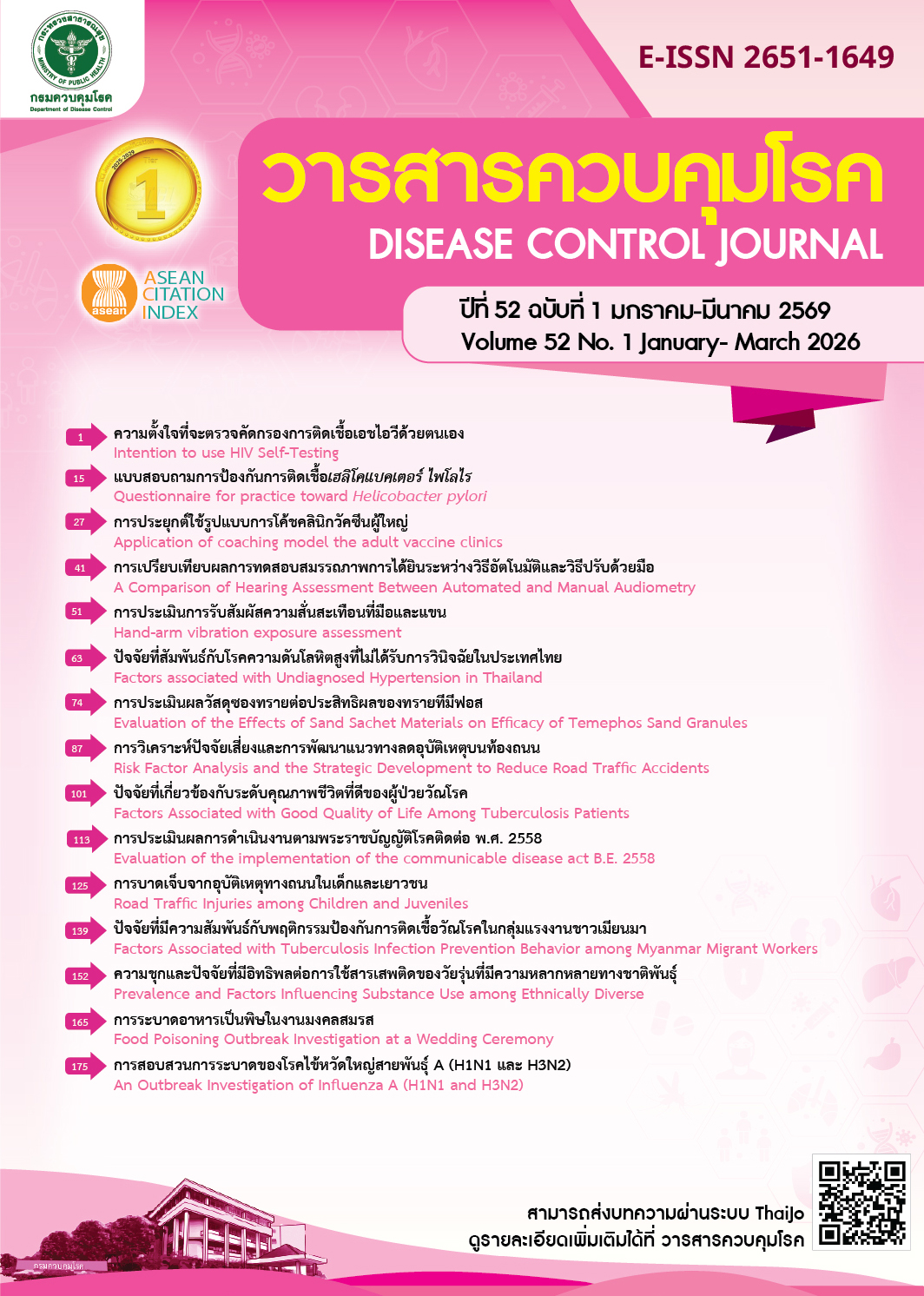
Translation and quality assessment of a questionnaire for practice toward Helicobacter pylori
DOI:
https://doi.org/10.14456/dcj.2026.2Keywords:
instrument translation, prevention, helicobacter pyloriAbstract
Helicobacter pylori infection is a preventable disease with correct practice. This study aimed to translate a questionnaire on practice toward Helicobacter pylori infection and to examine its content validity and reliability in the Thai version. The research design was a descriptive study, and it was conducted in two phases. Phase 1 involved the translation of the questionnaire using a forward-backward technique by professional translators from two independent university language institutes, followed by content validity assessment by five experts. Phase 2 focused on testing the reliability of the questionnaire in a sample of 30 individuals with dyspeptic symptoms who were at risk of the infection. Inclusion criteria were adults aged 20-59 years with a history of Helicobacter pylori testing. Participants were recruited from a tertiary hospital between July and August 2025. Data was analyzed using Cronbach’s alpha. The findings revealed that the Thai version of the questionnaire was conceptually equivalent to the original English version. Content validity was acceptable (Content Validity Index=0.91), and reliability was satisfactory, with a Cronbach’s alpha coefficient of 0.73. In conclusion, the translated questionnaire demonstrated good quality and can be applied to assess practice toward Helicobacter pylori infection in the Thai context.
Downloads
References
Chua BQ, Chong VW, Teng TZ, Chia CT, Aung MO, Shelat VG. Does technology‐enhanced communication improve Helicobacter pylori eradication outcomes? A meta-analysis. Helicobacter. 2022;27(3):e12890. doi:10.1111/hel.12890
Hooi JK, Lai WY, Ng WK, Suen MM, Underwood FE, Tanyingoh D, et al. Global prevalence of Helicobacter pylori infection: systematic review and meta-analysis. Gastroenterology. 2017;153(2):420-9. doi:10.1053/j.gastro.2017.04.022
Aumpan N, Issariyakulkarn N, Mahachai V, Graham D, Yamaoka Y, Vilaichone RK. Management of Helicobacter pylori treatment failures: A large population-based study (HP treatment failures trial). PLoS One. 2023;18(11):e0294403. doi: 10.1371/journal.pone.0294403.
Shitapanarak T. Acid peptic disease. Chiang Mai: TrickThink Printing; 2022. (in Thai)
Gastroenterological Association of Thailand. Clinical practice guideline for the diagnosis and treatment of Helicobacter pylori infection in Thailand 2015. Bangkok: Gastroenterological Association of Thailand; 2016. (in Thai)
Rattanachaisit P, Burana C, Jaroenlapnopparat A, Vongseenin S, Chaithongrat S, Rerknimitr R, et al. The prevalence and treatment outcomes of Helicobacter pylori infection in a tertiary hospital in Thailand, 2018-2021. JGH Open. 2023;7(6):439-44. doi: 10.1002/jgh3.12 916.
Sardar M, Kumar D, Aakash FN, Partab FN, Kumar S, Barkha FN, et al. Prevalence and etiology of Helicobacter pylori infection in dyspepsia patients: a hospital-based cross-sectional study. Ann Med Surg. 2023;85(4):665-9. doi: 10.1097/MS9.0000000000000120.
Department of Disease Control. Infection prevention and control [Internet]. Nonthaburi: Bureau of Information, Department of Disease Control, Ministry of Public Health; 2019 [cited 2025 Sep 1]. Available from: https://ddc.moph.go.th/bidi/pagecontent.php?page=543&dept=bidi (in Thai)
Alaridah N, Joudeh RM, Raba’a FJ, AlRefaei A, Shewaikani N, Nassr H, et al. Attitudes and Practices Regarding Helicobacter Pylori Infection Among the Public in Jordan: A Cross-Sectional Survey. Cureus. 2024;16(2):e55018. doi: 10.7759/cureus.55018.
Abongwa LE, Samje M, Antoine KS, Alberic S, Elvis M, Benardette L, et al. Knowledge, practice and prevalence of Helicobacter pylori infection in the north west region of Cameroon. Clin Biotechnol Microbiol. 2017;1(4):135-43.
World Health Organization. Health promotion and disease prevention [Internet]. Geneva: World Health Organization; 2024 [cited 2025 Jun 4]. Available from: https://www.emro.who.int/about-who/public-health-functions/health-promotion-disease-prevention.html
Sawatdipanich S, Tiensawat S. Translating instruments for cross-cultural research: techniques and key considerations. J Thailand Nurs Midwifery Counc. 2012;26(1):19-30. (in Thai)
Meeharnpong P, Chatdokmaiphai K. Quality assurance of nursing research instruments. J Royal Thai Army Nurses. 2018;19(1):9-15. (in Thai)
Brislin RW. Back-translation for cross-cultural research. J Cross Cult Psychol. 1970;1(3):185-216. doi: 10.1177/135910457000100301
Thato R. Nursing research: concepts to application. 7th ed. Bangkok: Chulalongkorn Printing; 2023. (in Thai)
Subsomwong P, Miftahussurur M, Uchida T, Vilaichone RK, Ratanachu-Ek T, Mahachai V, et al. Prevalence, risk factors, and virulence genes of Helicobacter pylori among dyspeptic patients in two different gastric cancer risk regions of Thailand. PLoS One. 2017;12(10) :e0187113. doi: 10.1371/journal.pone.0187113
Jiang Q, Liu WD, Hui WJ, Kong WJ, Feng Y, Kuerbanjiang A, et al. Prevalence and risk factors of Helicobacter pylori infection in Xinjiang Uygur Autonomous Region: A cross-sectional study of all age groups. World J Gastroenterol. 2025;31(21):106033. doi: 10.3748/wjg.v31.i21.106033
Rattanachaisit P, Burana C, Jaroenlapnopparat A, Vongseenin S, Chaithongrat S, Rerknimitr R, et al. The prevalence and treatment outcomes of Helicobacter pylori infection in a tertiary hospital in Thailand, 2018-2021. JGH Open. 2023;7(6):439-44. doi: 10.1002/jgh3.12916
Downloads
Published
How to Cite
Issue
Section
License
Copyright (c) 2026 Disease Control Journal

This work is licensed under a Creative Commons Attribution-NonCommercial-NoDerivatives 4.0 International License.
Articles published in the Disease Control Journal are considered as academic work, research or analysis of the personal opinion of the authors, not the opinion of the Thailand Department of Disease Control or editorial team. The authors must be responsible for their articles.